
Joseph Nathan, ThePaper.co.nz
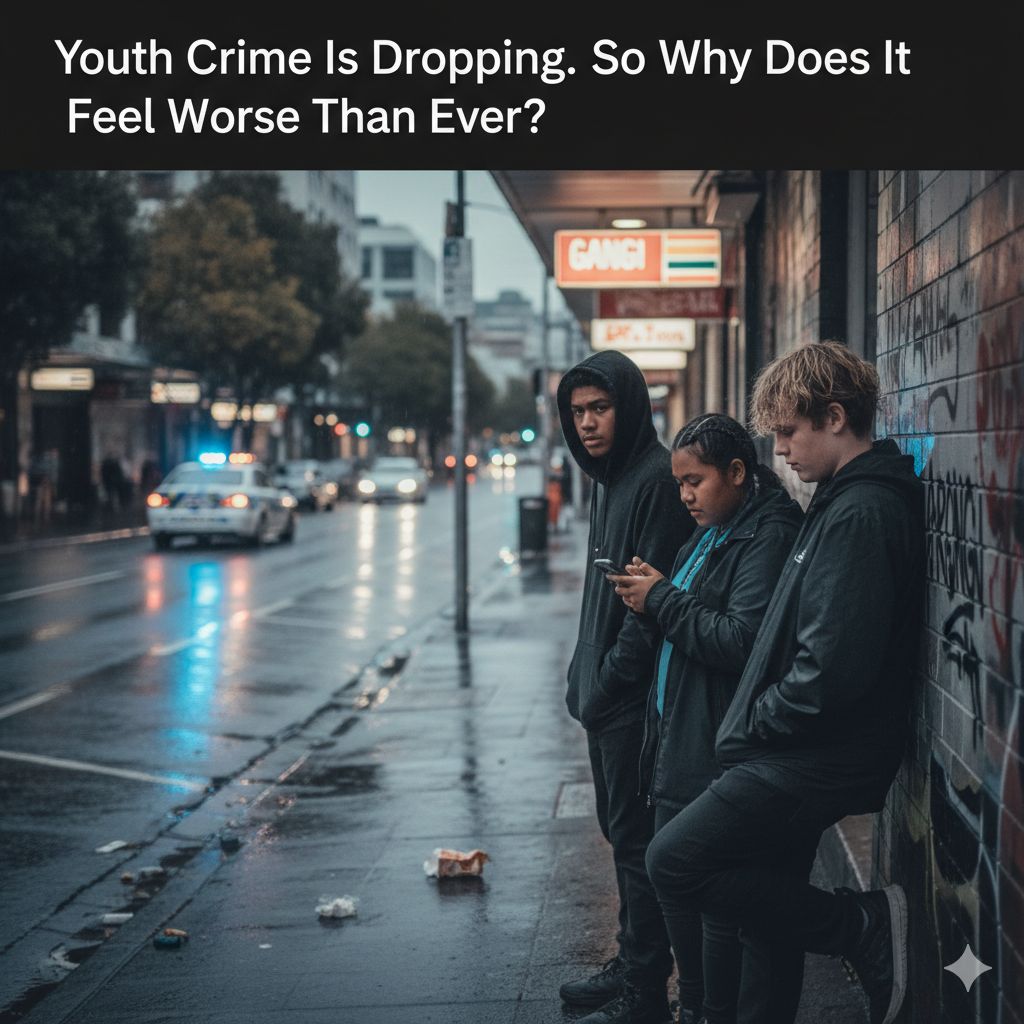
Walk down any main street after dark and you’ll hear the same conversation: ram raids, break-ins, teenagers running wild. But behind the headlines and the shaky CCTV clips, a quieter truth sits in the official data — youth crime in New Zealand is actually going down.
Not a little. A lot.
Over the past decade, offending by children and teenagers has steadily fallen. Fewer young people are turning up in the justice system, fewer are being charged, and fewer are ending up in front of a judge. Even the types of crimes that once dominated youth statistics — shoplifting, car theft, low-level assaults — have slashed back dramatically.
A senior youth caseworker describes it simply:
“Most young people today will never come near the justice system. That’s the part the public never hears.”
A Slow, Steady Decline
Long-term tracking shows one of the clearest trends in New Zealand’s social data: youth offending has been shrinking for more than ten years.
Fewer children aged 10–13 are entering the system.
Offending among 14–17-year-olds has dropped even faster.
The total number of young people charged with serious offences has fallen disproportionately to population growth.
A community youth advocate puts it bluntly:
“People assume things are getting worse because the worst incidents get 100 times more attention. But the big picture is the opposite — far fewer teens offend now compared to ten or fifteen years ago.”
But What About Ram Raids?
The spike in ram raids changed public perception dramatically. It was sudden, loud, and highly visible — smashed glass, stolen cars, viral videos.
But even that surge has eased off. Intensive policing, community-based interventions, and targeted support programmes have significantly reduced the frequency of these incidents.
One police youth engagement officer says the shift is evident on the ground:
“The same faces were involved again and again. Once we wrapped real support around those kids and their whānau, the numbers dropped. It wasn’t magic — it was consistency.”
Why the Drop Is Happening
Experts point to a mix of factors:
Early intervention is finally working
Schools, youth services, and frontline agencies are catching problems earlier. A counsellor at a South Auckland school says the biggest change isn’t behaviour — it’s support.
“Kids aren’t suddenly better behaved. They just have someone showing up before they hit crisis point.”
Policing has shifted
More visible patrols, specialist youth teams, and closer monitoring of at-risk kids mean fewer opportunities for reoffending.
Communities are stepping in
From sports clubs to iwi-led youth groups, more young people have stable adults around them — something proven to prevent first-time offending.
The Difference Between Noise and Reality
The contradiction is frustrating: youth crime feels worse, yet the data shows it’s not.
It comes down to visibility.
A single ram raid can dominate the news cycle for days. A random assault can spread online instantly. But the hundreds — even thousands — of kids quietly doing the right thing never make the front page.
A frontline social worker says the disconnect is understandable:
“If people only see the shocking stuff, they assume that’s the norm. But the kids doing well don’t trend on social media.”
The Real Challenge Now
Lower crime doesn’t mean no crime.
The small group still offending tends to:
be more vulnerable
face deeper social and family challenges
and require more intensive support
These cases often involve trauma, disrupted schooling, and unstable housing. For them, enforcement alone isn’t enough.
As one youth worker puts it:
“You can’t arrest your way out of the hardest cases. You need support, structure, and a reason for them to believe tomorrow can be better.”
A Quiet National Achievement
New Zealand has a habit of talking itself into crises, but in the case of youth crime, the long-term story is actually one of success.
Crime isn’t disappearing. Victims are real. Communities still carry fear. But the overall trajectory is a rare bright spot: the majority of young people are offending less, harming less, and choosing better paths than the generation before them.
That’s worth acknowledging.
Because when the public story is only about the worst kids doing the worst things, we miss the bigger victory — the slow, unglamorous, quietly hopeful decline of youth crime in New Zealand.
 The Paper